

A reliable foundation for microservices that need to change over time.
Record business events once ad reuse them everywhere - making systems easier to evolve, debug and trust.

Eliminate coordination glue
Record events once and stream them natively. No dual writes, no outbox patterns, no CDC pipelines to keep services in sync.

Ship faster, evolve safely
Focus on business logic instead of maintaining sagas, retries, and reconciliation jobs. Evolve data models through replay, not migrations.

Simplify your stack
One platform for durable storage, real-time streaming, and projections. Fewer systems to operate, fewer failure modes.
50M+
DOWNLOADS
F500
DEPLOYMENTS
μs
LATENCY
99.9%
UPTIME
SOC 2
CERTIFIED
From business processes to distributed complexity
Microservices and modular architectures are widely adopted to improve team autonomy and delivery velocity. In practice, however, teams quickly discover that the hardest part is not service boundaries or APIs—it's data. Each service owns its own database, updates propagate asynchronously, and no single place represents "what actually happened."

Data Inconsistency Across Services
Each service owns its own data, and consistency is achieved asynchronously. Over time, different services disagree about the current state of the business. Teams lose confidence because there is no single, authoritative record of what actually happened.

Tight Coupling vs. Fragmented Data
Shared databases undermine service autonomy and make schema changes risky, while isolated databases make even simple data access patterns complex. As the system grows, data ownership becomes unclear.

Distributed Transactions & Fragile Workflows
Business processes that span multiple services require coordination across databases without shared transactional boundaries. Teams implement sagas, retries, and compensating actions—mixing business logic with failure handling.

Dual Writes & Reliability Workarounds
To keep services in sync, teams write to a database and publish an event as two separate operations. When one succeeds and the other fails, data integrity is compromised. Outbox and CDC patterns add infrastructure and failure modes.

Reconstructing Past State & Debugging
When something goes wrong, teams can't answer "what did the system believe at that point in time?" Logs and snapshots provide partial clues but rarely allow deterministic reconstruction of behavior.

Projection & Read Model Management
Events need transformation into read models. General-purpose databases require external frameworks, custom microservices, or batch jobs—plus checkpoint management and synchronization logic.
The Microservices Complexity Tax
Data Fragmentation
Coordination Overhead
Operational Sprawl
Audit & Compliance Risk
Delivery Slowdown
Rising Infrastructure Cost
Microservices without the mess
Microservices promise agility, but coordinating data across distributed services creates complexity. KurrentDB eliminates this challenge by making events the foundation of your architecture. Building on the principles of event sourcing and CQRS, services stay loosely coupled yet perfectly synchronized—no brittle point-to-point integrations, no distributed transaction headaches, just clean event-driven communication that scales.
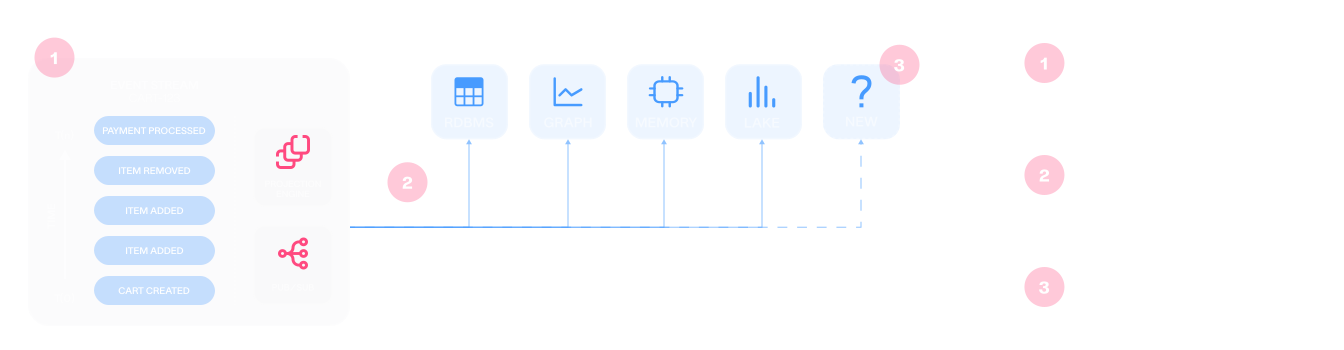
Event-Native Data Model
Guaranteed Ordering & Concurrency
Durable Storage & Real-Time Streaming
Decoupled Read & Write Models
Deterministic Replay
Schema Evolution Without Downtime
High Performance Stream Indexing
Built-In Audit & Traceability
Native SDKs for Major Languages
KurrentDB in a microservices architecture
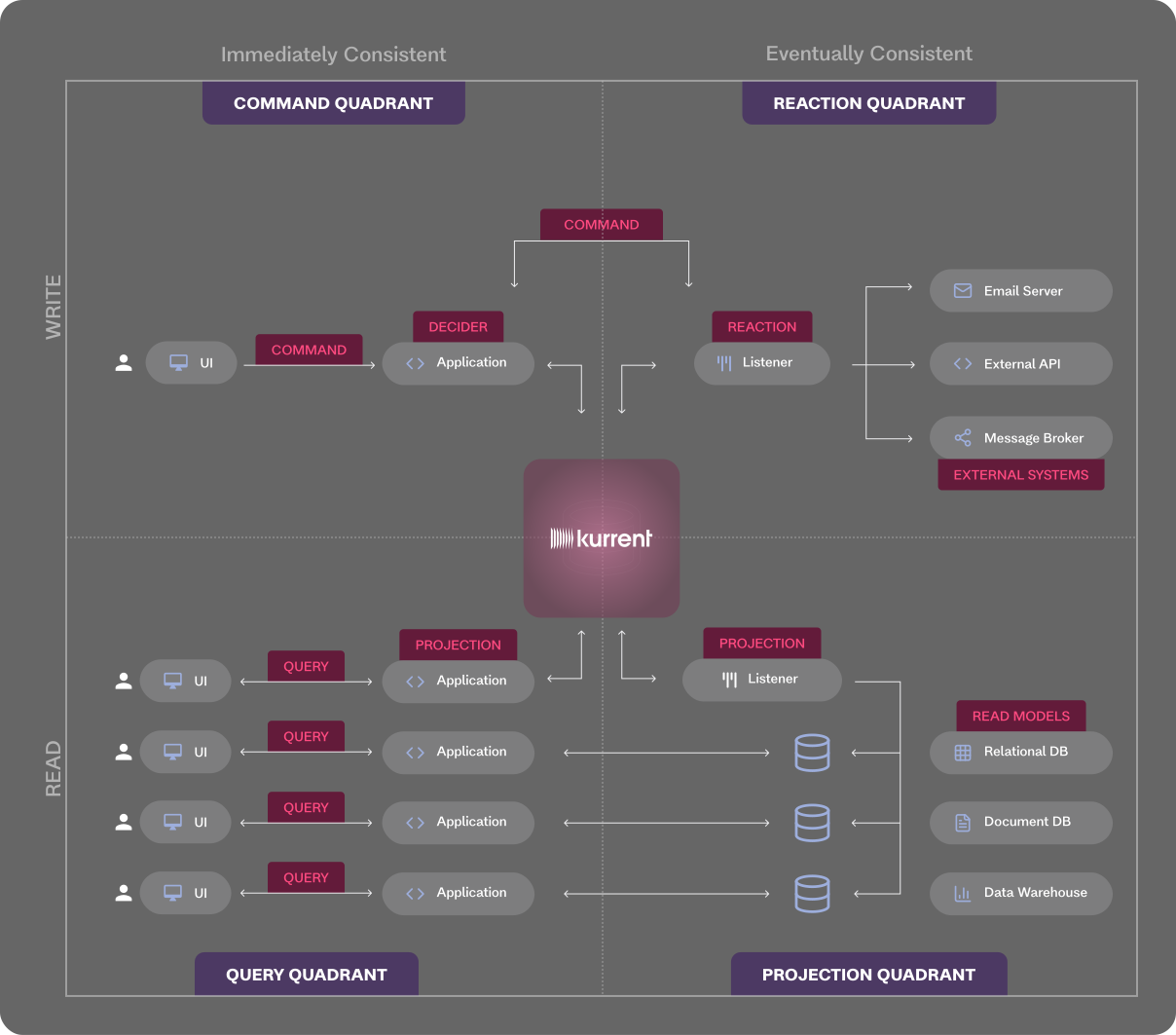
In a microservices architecture, business events flow through services and are persisted to KurrentDB as the single source of truth. Projections transform events into read-optimized models for queries, while reactions listen to events and trigger downstream services. Teams record what happened once and reuse it everywhere—with immediate consistency for commands and eventual consistency for projections and reactions.
Plug-and-play vs. infrastructure project
Most teams don't struggle because they chose the wrong architecture pattern. They struggle because traditional databases and messaging systems were never designed to jointly guarantee ordering, history, and auditability across distributed services. KurrentDB addresses these problems natively—preserving the ordered history of business actions in a single, reusable backbone.
Traditional
Kurrent
Split between database state and message log
Source of Truth
Single, event-native system of record
Separate systems with coordination required
Data Storage & Streaming
Built-in - same technology
Dual writes - outbox or CDC needed
Write & Publish Consistency
Guaranteed - single write path
Partition-based or application-managed
Event Ordering
Guaranteed - per stream and global
Custom logic across database and broker
Concurrency Control
Native - stream level
Limited by broker retention and offsets
Replay & Time-Travel
Native - unlimited history
External stream processors required
Read Models & Transformations
Built-in projection engine
Migrations, backfills and reprocessing jobs
Schema & Model Evolution
Rebuild via replay
Multiple systems, configs and failure modes
Operational Footprint
One system to operate
High - state, messages and CDC can diverge
Risk of Data Drift
Minimal - single canonical log
Source of Truth
Split between database state and message log
Single, event-native system of record
Data Storage & Streaming
Separate systems with coordination required
Built-in - same technology
Write & Publish Consistency
Dual writes - outbox or CDC needed
Guaranteed - single write path
Event Ordering
Partition-based or application-managed
Guaranteed - per stream and global
Concurrency Control
Custom logic across database and broker
Native - stream level
Replay & Time-Travel
Limited by broker retention and offsets
Native - unlimited history
Read Models & Transformations
External stream processors required
Built-in projection engine
Schema & Model Evolution
Migrations, backfills and reprocessing jobs
Rebuild via replay
Operational Footprint
Multiple systems, configs and failure modes
One system to operate
Risk of Data Drift
High - state, messages and CDC can diverge
Minimal - single canonical log

Deploy Your Way
Choose the deployment model that fits your needs


Kurrent Cloud
Focus on your application while we manage the infrastructure.

Kurrent Enterprise
Run and manage KurrentDB yourself with full control and support.

